Wednesday, October 09, 2013

Remembering a Friend's Mother

My beloved brother David,

If you wish me to share your thoughts regarding my mom, please e-mail them to me before Sunday, October 13th.  The memorial service will be at 3:00pm in Irvine.

In His love, by His grace and for His glory,

George

My memories of Beverly go back more than half a century, when my family and her family were neighbors on the same block in Northridge. I lived at that house from April 1953 to December 1961. Her son George and I were best friends in those wonderful days, for the 1950s were perhaps the best time in the history of our country to be a kid. George  and I were frequently in each other's homes during those years, playing sandlot baseball, collecting and trading baseball cards, reading comic books, dressing up as superheroes in costumes we made ourselves out of old bedsheets, being taken by our parents to special places on our birthdays, and under their careful supervision swimming on hot summer days. On the day we received our weekly allowances, we were driven to Frank's Liquor Store to purchase five-cent packs of baseball cards, each containing five cards and a generous stick of bubble gum. We played army in the black walnut orchard near our homes, and harvested pomegranates from untended trees in the nearby fields.

Beverly was a wonderful host, and a great 1950s mom to her family and her children's friends. I remember frequent overnights in each other's homes, sharing dinners (including barbecues), making breakfast after getting out of our sleeping bags after a sleepover, and dishing out ice cream on hot summer afternoons. We watched television shows like "Sky King" and "Supercar" and "The Adventures of Robin Hood"--black and white shows, of course. 

Our mothers set the rules as we rode our bikes through our neighborhood, and occasionally cycled two miles west along shaded Rayen Street to Northridge's "downtown" on Reseda Boulevard. In those days, once we were out of sight we were also out of touch, for there were no mobile phones--but also in those days we could be gone for hours and never feel that we might be unsafe. 

Our mothers took care of us when we dressed up for Halloween and went door-to-door through the neighborhood. The day after Halloween we would organize and compare and trade the mountains of candy we had acquired. 

These were the days when we were children and our parents were young, days that made an indelible impression on our lives. They were days of innocence and hope, when our fathers provided for our families and our mothers made the homes in which our families lived. Our parents gave us our lives, and then shaped them as we grew. They gave us standards, standards they had learned in their own days of growing up, in the generation before ours that had known hardship and war--but to their children they gave an era of optimism and plenty. Rightly has their generation been called "The Greatest Generation" our country has ever produced.

I give thanks to God for the time in which we grew up as children, for our parents who set us on the track, and for Beverly in particularly, who was a vital part of my own growing-up years. 

Monday, October 07, 2013

Our Lady of the Rosary

October 7 is the feast of Our Lady of the Rosary. The rosary is a way of praying, meditating, and doing Bible study. Its beginnings go back to the days of the beginning of Christian monasticism in the deserts of Egypt in the fourth century, but its current form may go back to the days of St. Dominic, who lived in the late twelfth and early thirteenth centuries.


How does one use the rosary? It’s sort of like what happens when you read. The words on the page inspire your imagination. Especially when one reads fiction, the images of places, what voices sound like, and so forth can only be described by the writer up to a certain point. After that the imagination of the reader must take over to give life to the story.

There is a form of prayer like that; it is a form of meditation, which can be done very simply or very deeply. The rosary is a particular kind of meditation. The purpose of the rosary is to help keep in our minds and hearts and wills certain principal events or mysteries in the history of our salvation, to thank and praise God for them, and to grow more and more in love with God. By meditating on key events in the life and ministry of Jesus and his promises to the faithful, we can conform our lives better to his will for us. We also learn to love others better, and through the rosary we can even pray for others.

There are twenty mysteries reflected upon in the Rosary, which are divided into five sets of four:

The five Joyful Mysteries are about Jesus’ childhood:
1.       The Angel Gabriel Announces to Mary that She has been Chosen to be the Mother of the Messiah
2.      Mary Visits Elizabeth, the Mother of John the Baptist
3.      Jesus is Born in Bethlehem
4.      Mary and Joseph Bring Jesus to the Temple When He is Forty Days Old
5.      Mary and Joseph Find Jesus in the Temple When He is Twelve Years Old

The five Luminous Mysteries are about his earthly ministry:
1.       Jesus is Baptized in the River Jordan
2.      Jesus Changes Water into Wine at a Wedding in Cana
3.      Jesus Preaches the Kingdom of God
4.      Jesus in Transfigured
5.      Jesus Institutes the Eucharist at the Last Supper

The five Sorrowful Mysteries are about his suffering and death:
1.       Jesus Prays in the Garden Before He is Arrested
2.      The Soldiers Whip Jesus
3.      The Soldiers Put a Crown of Thorns on Jesus’ Head
4.      Jesus Carries His Cross Through the Streets of Jerusalem
5.      The Soldiers Crucify Jesus

The five Glorious Mysteries are about his resurrection and the promise of eternal life:
1.       Jesus Rises From the Dead
2.      Jesus Returns to Heaven
3.      The Holy Spirit Comes On the First Believers
4.      Mary is Taken into Heaven After She Dies
5.      Mary is Crowned as the Queen of Heaven

For well over a hundred years, there has been an intercessory guild within the Anglican Communion that uses the rosary. It is called the Guild of the Living Rosary. It was founded in England in October 1905. The Guild is Anglican-based, but membership is open to any Christian.

Members are asked to pray just one decade of the rosary each day with a special intention. Intercession sheets with the intentions are produced three times a year and are provided to the members before the first days of January, May, and September.

Though one decade may seem a small prayer to ask, one benefit of membership in the Guild is that one prays with nineteen other members to comprise an entire rosary of twenty mysteries. One can be assured that in partnership with others an entire rosary is prayed with the appointed intercession. I have been a member of this guild for over forty years, and found it to be a powerful means of prayer and growing in love with Jesus and learning how to do so through the example and leadership of the Virgin Mary. (See my blogpost from November 1, 2006 http://johnonefive.blogspot.com/2006/11/ave-maria-gratia-plena.html)

Anyone who may be interested in the Guild is asked to write to guildlivingrosary(at)gmail.com

Saturday, July 13, 2013

The Joy of Explosives

About five years ago I wrote this blogpost <http://johnonefive.blogspot.com/2008/12/evidence-that-god-loves-me.html> in which I describe explosive devices I made when I was a teenager. They were assembled from wax paper, a suitable weight like a marble or a construction bolt, and gunpowder that I carefully and painstakingly scraped out of caps for cap pistols.

Well, that kind of gunpowder seems to be all but disappeared from the scene. So you can imagine my surprise and wholesome delight when I found some caps in a store not long ago. Being now older and mature and therefore confident that I could handle such material safely, I bought some.

Brimming with excitement, I came home and carefully extracted the gunpowder from the caps. My hands were trembling with anticipation, but I still managed to create a small pile of the precious powder. Wax paper and construction bolts were, of course, easy to procure. With clear eyes and careful craftsmanship, I assembled a bomb: I placed a generous pile of gunpowder onto a square of wax paper and positioned a bolt over it. Then I dexterously twirled the wax paper into its characteristic teardrop shape.

Before going onto the street, I held the result in an open palm, a little damp with the emotion of the moment. I hadn’t seen such a beautiful thing for several decades, and, although eager to put it to use, I hesitated. I was not averse to throwing the item—oh no—I merely wanted to drink deeply of the exquisiteness of the imminent event. With an indulgent grin, I remembered that Winnie the Pooh had sagely observed that the moment just before the honey pot touches your lips is, somehow, perhaps, even more wonderful than the first taste of the honey.

At peace with the world, and gratefully marveling at the wonder of how the remembered pleasure of past explosions could cross the decades and swell the enjoyment of the coming detonation, I went outside. I paused at the foot of the driveway and viewed the cul-de-sac that stretched before me. I smiled wryly as I considered the possibility of neighbors going calmly about their homey business in a safe and quiet community, completely unsuspecting of the energy about to be released.

I threw the waxen teardrop upwards and watched breathlessly as it described a perfect parabola. With the full force of gravity, it struck the pavement sharply.

Fffffffftt.

That was it. A mere whisper. A mild exhalation as of a sudden short sigh. A cat’s yawn. No, maybe a kitten’s yawn. If fleas sneeze, it would have been like that.

After the chill of disappointment dashed over me, my next reaction was embarrassment. I hoped that no neighbors had been looking out of their window at the moment of my humiliation, thereby intensifying it beyond tolerability. With narrowed eyes, I took a quick scan of the nearest houses. I saw no quickly withdrawn face, and felt relief.

Then I needed someone to blame. I had a suspicion. My lips pursed and my eyebrows lowered. Then my nostrils flared.

To confirm my hypothesis, I strode out to where the bolt lay harmlessly on the asphalt. Feverishly I crumpled  a piece of newspaper I had with me and lay the entire roll of caps in it and set it on fire. Barely audible puffs manifested. I had to bend down and turn my head so that my ear was close to the burning newspaper.  Fffft. Fffft.. fffft.

That was it. If there were germs on the nearby pavement, maybe they would have heard explosions, but I doubt it. To me, it sounded as if a mouse was using an aerosol can.

I came to my feet. I knew whom to blame. Insurance companies. The very people who have been quietly sapping all joy out of life for decades. The people who forbid the building of treehouses. Who saw to the removal of diving boards at motels. Who ensured the removal of BB guns and any toys with small moving parts from the shelves of toystores. The people who want to make the world completely safe and devoid of risk and therefore all of the immense joys for which risk is an essential prerequisite.

They should be sued. Obviously it’d be next to impossible to bomb their offices.


Friday, June 21, 2013

The White Stone

When I was in seminary, I was introduced to some English humor. One of the best of what I suppose we’d call stand up comics today was Peter Cook, who was the leading performer in Beyond the Fringe. He did a brief one-man skit called “The Miner”, in which an individual of limited academic achievement tells the audience that he wanted to be a judge, but lacked Latin; so he became a coal miner. In the skit, he says that when you want to become a coal miner, “They only ask you one question; they say, ‘Who are you?’—and I got 75% on that one.”

For those who want to see the entire skit of a little more than two minutes, it’s here: http://www.youtube.com/watch?v=Grg5tULy0tY

This was more than forty years ago, and I suspect that what people think is funny has changed since then. Still, I remembered that line about getting 75% on knowing who you are, and came to realize that, taken out of the comedic realm, it can be profound.

I put it together with an odd sentence in the last book of the Bible: Revelation 2:17— “To the one who conquers I will give … a white stone, with a new name written on the stone that no one knows except the one who receives it.”

When I first read that line years ago, I wondered what good it would be to have a name that no one else will know. Aren’t names the very things we use to let other people know who we are? Of course, in this passage Jesus is not referring to a label for oneself by which others will know us, but rather it is the gift of self-knowledge that comes only when one is fully known by Jesus. Which is the only way to do it.

And later it struck me that to get the White Stone with the name, one has to “conquer”—that is, one has to endure a battle of some kind and come out triumphant. And one receives a White Stone and not a calling card or a whispered word. The stone is a sign of permanence, and it is white as a sign of purity, or perhaps joy. Or both.

As is often pointed out, the Christian life is a life of battle. We are in “enemy-occupied territory”, taught C. S. Lewis. I used to preach that the Christian life was not merely about studying, gaining knowledge, growing in maturity, and gradually becoming holier; it is about fighting and prevailing. “Whoever endures to the end shall be saved.” There are lots of other verses that say the same thing.

But if we engage in battle, do we not often fail? Are we not often defeated? In nearly forty years as a priest of traditional convictions, I think that I lost nearly every battle I ever fought in the Episcopal Church. Still, I wrote this blogpost more than six and a half years ago: Jawbone of an Ass http://johnonefive.blogspot.com/2006/10/jawbone-of-ass.html. I wrote a number of other blogposts on the same theme.

Eventually I became exhausted, emotionally, spiritually, and even physically, and I was not recovering. And I remembered that a noted psychologist/spiritual director I saw for two intense long-term periods told me once that when his mother was 84 and still caring for her family by hosting big dinners and so forth, he said to her, “Mom, there comes a time when it is okay to lay down the burden.” “Is that time now?” she answered.

My time came. But still often I feel like a failure—as if I have lost the battle. Sins, weaknesses, hurts, missteps, and all the rest of it have plagued me all my life, or so it seems. But then I realized that I was measuring my successes—and failures—by a self-oriented standard, the standard of perfectionism and trying to “do it all” myself. I know that there were many successes too. And probably a lot that I can’t even evaluate and don’t need to evaluate. I just know that I did my best.

Now that I have been retired for more than seven months, I am learning what the White Stone is about. Or at least learning it in a new way. Having been wounded and exhausted in striving for the Faith and for holiness, I am coming to learn in a new way my complete need for God and utter dependence on him, and that only in this is the way forward. And I came to see “failures” in an entirely new way. Without diminishing or belittling the reality of the failures of prominent Biblical personalities, I came to see how God uses those failures to build holiness and create triumph.

Eve failed, yet she was still the mother of all living, whose seed would crush the serpent’s head.

Noah found favor with God and obeyed him, but sinned after the ark settled down in a new world, thereby bringing sin right back into that world. And through him all the descendants of the world came to be.

Abraham believed God and it was counted to him as righteousness, and he left home for an unseen land, but failed by becoming impatient with God’s promise of a son, and fathered Ishmael; yet Ishmael also became the father of a nation.

Isaac failed by preferring one son over the other, yet held faithful as the middle of the three patriarchs, and the younger son was not thwarted in his vocation even if he was not his father’s choice.

That son Jacob failed, deceiving his father and brother, and offered a prayer at Bethel that showed only conditional faith in God, yet God continued to bless and provide for him so that he matured in his faith, and on his return home, sought reconciliation with his brother.

Joseph failed by jerking his brothers around when he was Lord of Egypt, yet God blessed him, fulfilled his dream, and ensured the preservation of the descendants of Abraham even through slavery.

Moses, though he dedicated his life to obeying and serving God and leading a very trying and rebellious people, failed to uphold God’s sovereignty and was not admitted to the Promised Land; yet he is still regarded as the great deliverer and law giver.

David, a great warrior who subdued all of Israel’s enemies and set the standard of Jewish kingship, nonetheless failed. He was called a “man of blood”, he was an adulterer and murderer, and was a notoriously poor father and dismally inept in all his family relationships; yet he established an everlasting kingdom and gave his name to the Messiah.

His son Solomon began his kingship with a prayer asking for wisdom, and he built the Temple, but at the end he tolerated the admittance of foreign deities into the kingdom, and he did not prepare his son for rule.

James and John were brothers chosen by Jesus and counted in the inner circle of the disciples, but they failed, arguing over who the greatest was, and wanting to sit at the side of Jesus in the kingdom; they were called “Sons of Thunder” for an apparent violent temper; yet one was the first apostolic martyr and the other was the guardian of Mary and the writer of the magnificent Gospel.

Peter and all disciples were chosen and called by Jesus, but failed, abandoning and denying Jesus at the time of his trial, but eleven of them became the chosen foundation of the Church which endures in power and influence and truth and love even to this day.

Paul failed as a Pharisee and a disciple of Gamaliel (the wise and tolerant), and became a rigid persecutor of the Church even violating the Jewish Law to do so; and as a Christian he broke with Barnabas over a disagreement; yet he obviously bore immeasurable fruit and closed his life as a martyr and with the words, “I have kept the faith.”

Failing in God’s service puts one in good company. Paul put it best when he related that God said to him, “My grace is sufficient for you” and he responded, “When I am weak, then I am strong.” Failure is only true failure if one gives up. Otherwise, it is woundedness in the battle.

Recently someone shared with me the theme from the movie Shrek, which I haven’t seen and was not familiar with. She especially pointed me to the third verse:

    I did my best, it wasn't much.
    I couldn't feel, so I tried to touch.
    I’ve told the truth, I didn’t come to fool you.
    And even though it all went wrong,
        I'll stand before the Lord of Song
            with nothing on my tongue but Hallelujah.

And then I read Wild at Heart, by John Eldredge. He points out that the first Biblical verse Jesus selected to define his public ministry was Isaiah 61:1— “The Spirit of the Sovereign Lord is on me, because the Lord has anointed me to preach good news to the poor. He has sent me to bind up the brokenhearted, to proclaim freedom for the captives and release for the prisoners.”

This is what I want and need. Sure, I failed sometimes, and once in a while even spectacularly. But not always. If I had hidden and protected myself, I might not have sustained the wounds that I did, but I would never have become a man, either. Becoming a man involves battle and sustaining wounds. But I still stand, and I look for the freedom that Jesus promises captives.

And the White Stone. When Jesus asks me, “Who are you?” I want to get 100% on that one. But no one can do that without the White Stone that only he can give.

Wednesday, May 15, 2013

Forests and Cities

Charles Walter Stansby Williams died 68 years ago today—on May 15, 1945. Along with J. R. R. Tolkien and C. S. Lewis, these three were the most influential and best known of the Inklings, although Williams came late to the group and is nowhere near as famous or influential as the other two. Williams lived and worked in London, but removed to Oxford during the second World War when many people were evacuated during the frequent bombings of the great cities of England by the Germans.

The move was fortuitous for Williams. He and Lewis had become friends, first by mail over mutual admiration of their writings, and then by rare personal visits. Williams’ evacuation to Oxford made it possible for him to attend the meetings of the Inklings for at least a short time. Lewis had become a great admirer of Williams and welcomed him with gusto to the gatherings of the Inklings.

It is a matter of impressive curiosity to me that Lewis would be so taken by Williams. I doubt that Lewis impressed easily. His relationship with Tolkien, which had been very close for many years, suffered greatly as a result of Lewis’ admiration of Williams, and never fully recovered. One facet of my curiosity is that both Lewis and Tolkien, as is evident in their writings, deplored Large Cities and Machinery and Industrialism, but Williams had quite the opposite view.

Tolkien’s love of the countryside is shown by his representation of the Shire in The Hobbit and Lord of the Rings. Trees were so beloved by him that he even made them sentient beings in the ents. By contrast, the renegade wizard Saruman turned his fortress into a factory that belched poisonous smoke, and wicked Orcs and others cut down trees at will. As Tolkien himself wrote somewhere, the Shire was essentially late 19th century rural England, with its mills and streams and woods and gentle farms. The closing chapters of Lord of the Rings show the conquered and occupied Shire turned into a barren industrialized town with many trees wantonly removed and many of its cottages torn down and replaced by sterile brick box-type buildings. It is cleansed by having these presences removed forcibly and quickly, and the Shire returned to its rural charm.

In a similar way, Lewis loved his cross-country walks with friends, and such walks feature in his fiction, such as Out of the Silent Planet. Narnia is clearly a land of villages with many woods and streams. Lantern Waste and The Wood Between the Worlds are clearly rural and peaceful. He loved his woods and the small pond a stone’s throw from his home, The Kilns, in Oxford.

By sharp contrast, Williams loved the clank of machinery and the bustle of buses, banks, and businesses in the large city. For him London was suggestive of the City of God—more than that, every large city was in some way a veritable manifestation of the Kingdom of God. In the cities, people worked in a commotion of exchange of money, goods, and services that not only suggested but factually were the Kingdom. As he wrote somewhere—I cannot place where at the moment—one cannot enter a tea shop and drink a cup of tea without touching the entire world: growers, printers, truckers, manufacturers, etc. etc., even going far back in history to the people who first harvested tea and invented crockery, built tables and chairs, and developed money, etc. etc. To him, everything was the Kingdom, and the City manifested it with euphoric excitement and joy.

Certainly, in a way both views must be correct. Putting them together makes for a stunning, eye-opening, revelatory insight into the Ways of God and the World, and such an insight changed my view of these Ways for ever.

Williams died during a rather simple surgery in Oxford. In his short time in Oxford he influenced the population, especially the student population, far more than many scholars who had lived and taught there all their lives. If I had to choose between his worldview and Tolkien and Lewis’, I confess that I’d pick the latter, but Williams has “baptized” my experience of the City too.

Monday, April 15, 2013

Daily First Prayer


It has been one year precisely since I last posted on this blog. More than one person has asked me why I stopped blogging, and urged me to pick it up again. It has been a trying year, but now I am ready to resume blogging. As I look over this blog’s statistics in the past twelve months, I note with satisfaction that the number of followers of this blog increased during the silent year from 43 to 53.

So now I have ideas for several blogposts that I hope to put here in the next few weeks. Working titles are “Sabbath and Retirement”, “Chrysalis”, “The Joy of Explosives”, “Paul in Jerusalem”, “Forests and Cities”, “Moses”, “Sky and Sea”, and “His Blood Be On Us”.

But I’ll begin with “Daily First Prayer”.

For many years I have maintained a prayer journal. It is a living document—that is, I am constantly writing and rewriting it as my life changes. A small part of it has been creating and refining what I call “Daily First Prayer”. I start each day with the following words (or similar words—I don’t just read it, but rather pray it from memory).

Thank you for the beginning of this day,
with its promise and potential
I commit myself to the practice and pursuit this day
of sanctity above all else
Guide and bless my labors and doings this day [especially ___ ]
Defend me in all times of assault, danger, and temptation
            Give me a strong sense of the constant fellowship of your Saints
Help me, like them, to choose and desire only what is good
and to cleave to it;
to resist, reject, and abhor all that is evil;
and to be able to discern the difference
when it is difficult for me to do so
Grant me grace that I may show forth the fruits of the Spirit,
and that my life may be a radiant and effective testimony to Jesus
I love you, O Lord my God; help me to love you
with my whole heart, mind, soul, and strength
Help me to trust in your guidance and providence in all situations,
and to look for and find blessings in all circumstances
Grant me grace that I may truly love all people,
freely receive love from others in the way they offer it,
and strive always to see myself as you do, as the rule of self regard

On Wednesdays and Fridays I add

Whenever I sin, bridge the gap of my failings
and bless any who might be harmed because of me
Then show me my sin, bring me to repentance and confession,
have mercy on me, forgive me, restore me to you, and
grant reconciliation with any whom I have offended
Help me to forgive those who have sinned against me
and to find blessing in the circumstances of their sin
Give me desire and grace for amendment of life

It’s taken several years to refine this prayer, and I suppose that it isn’t finished yet. Line by line, this is what I mean by it:

Thank you for the beginning of this day,
with its promise and potential
Each day begins with hope and intention for my coming more and more to know and love and serve God. Such an attitude or commitment dispels depression and discouragement at the beginning of the day, and puts the focus on God first.

I commit myself to the practice and pursuit this day
of sanctity above all else
Some years back I changed a request that God make me holy to a commitment or promise to practice it. That turns what could have been a constant petition into a proactive intention. Always asking implies that I am comfortable remaining immature in Christ. If I am truly to become holy, I must ask for it indeed, but must also make decisions and choose actions that are holy. Adding the word “pursuit” shows that I recognize that growing in sanctity must be a lifelong pattern.

Guide and bless my labors and doings this day [especially ___ ]
            Clearly, the day’s specifics are mentioned here. This will include prayer for all the people with whom I expect to have any contact, whether by email, telephone, or in person; and every task or errand or time of rest that I can anticipate. I lay the day’s realities before God and put them under his sovereignty.

Defend me in all times of assault, danger, and temptation
I pray God’s protection in wisdom, patience, and all virtue whenever someone attacks me for any reason and by any means (it’s usually by email); whenever danger threatens in any way; and whenever I am drawn to something apart from the will of God.

            Give me a strong sense of the constant fellowship of your Saints
            It is a great strength of the Catholic faith and one of the great birthrights of and gifts to each believer that we are “surrounded by a great cloud of witnesses” (Hebrews 12:1). Every date has a variety of the heroes and heroines of the Faith associated with it. Each disciple must keep his eyes and desires away from what is worthless and deceptive and turned toward what is within the will of God, and the Saints’ examples, encouragement, and living prayers are resources of incalculable power.

Help me, like them, to choose and desire only what is good
and to cleave to it;
“Choosing” what is good will often comes before a desire for it. Making a choice is an act of will, and choice is a primary characteristic of human nature. God gives us the dignity of choice in all things, and by our choices we shape our souls. So first we choose it, then we come to desire it, and finally we cleave to what we have chosen. I ask that the Saints’ influence will be a resource to help me become like them in these matters.

to resist, reject, and abhor all that is evil;
Though we are surrounded by a cloud of witnesses, we are also “assaulted by many temptations”. Just as choice precedes desire, so resistance must precede rejection. Cleaving to what is good is enhanced by an abhorrence of all evil.

and to be able to discern the difference
when it is difficult for me to do so
Moral and spiritual blacks and whites do abound, but in most instances we perceive shades of gray. Although ignorance of God’s will is taken into consideration by him, and our good desires are evidence of our striving to walking the road to heaven, many of our real life situations can be very complex. In such times, a prayer for discernment is needed that we may be shown the will of God.

Grant me grace that I may show forth the fruits of the Spirit,
            The fruits of the Spirit, namely “love, joy, peace, patience, kindness, goodness, faithfulness, gentleness, and self-control”, are the outworking or manifestation of a godly life. Inward attitude and commitment must be evident to those in the world in which we live.

and that my life may be a radiant and effective testimony to Jesus
and the consequence of showing forth the fruits of the Spirit must be a pointing to Jesus and his effectiveness in our lives.

I love you, O Lord my God; help me to love you
with my whole heart, mind, soul, and strength
Inspired by the appeal of the man with the demoniac son who said, “I believe! Help me in my unbelief!” (Mark 9:24), so this statement begins with my genuine but only human love of God, which, in its very essence, asks for grace to love God as he commands—that we love him with everything that it means to be human, to be ourselves.

Help me to trust in your guidance and providence in all situations,
and to look for and find blessings in all circumstances
Love of God is immediately applied in how we receive, perceive, and work that love in the complexities of real life. Some situations we face are tremendously painful or otherwise awful. Whether they are God’s will for us or not, they are at least permitted by God, and we are to trust that he is present in them, has not abandoned us, and that there is always a blessing to be found. Very often, however, we must LOOK for the blessing if we are to find it; if we don’t look, we usually confine ourselves to a smaller vision of what we can see and thereby miss many good things that are right in front of us.

Grant me grace that I may truly love all people,
            As Jesus taught, the love of God must include the love of neighbor as one loves oneself. It is easy to love the stranger, and often more difficult to love those we know and see regularly. This petition asks that our love of all people, the “neighbors” of Jesus’ parable of the Good Samaritan, must be “true”—not merely a feeling or sentiment, but a soul-deep reality manifested in attitude and action.

freely receive love from others in the way they offer it,
This line accepts that other people are as flawed as we are, and that their love shown to us may be egregiously tainted or misguided. We are to give them the benefit of the doubt, assume that they are doing their best, not prejudiciously attribute duplicity to them, and trust that they are loving us.

and strive always to see myself as you do, as the rule of self regard
            Yet, whether people love us or hate us or are indifferent to us, or whatever their attitude toward us and whatever their motives behind their attitudes toward us, we are to strive to regard our selves, our own worth, by God’s standard alone. This is how we must love ourselves, which is the basis of our measure of loving others: how does God see us? As a corollary, how does God see others? Any other standard for love will be distorted and deceptive. As Paul wrote, “With me it is a very small thing that I should be judged by you or by any human court. In fact, I do not even judge myself” (1 Corinthians 4:3). And for every servant of the Lord, “It is before his own master that he stands or falls. And he will be upheld, for the Lord is able to make him stand” (Romans 14:4).

Whenever I sin, bridge the gap of my failings
and bless any who might be harmed because of me
            Knowing that I am a sinner, in my confession I ask first not for forgiveness, but I pray first for those who are caused to suffer because of me. The prayer is that God will “bridge the gap”, i.e. make good on whatever harm I have done others by providing a blessing to them through or in place of the hurt.

Then show me my sin, bring me to repentance and confession,
have mercy on me, forgive me, restore me to you, and
grant reconciliation with any whom I have offended
This is the normal order of events in which one is set right with God after a sin. One must first know that one has sinned, then be convicted of the sin or brought to repentance. Confession of the sin must follow that, at which time mercy can be shown. Mercy leads to forgiveness, and after forgiveness the broken relationship with God is restored. Finally, reconciliation with the victims of one’s sins must be a consequence of forgiveness from God, or that forgiveness normally cannot be complete. Of course, reconciliation with others depends upon them as well, and the depth of their own sins and their own sinfulness can delay or prevent full reconciliation. In such a case, their own sins come into play, and one’s own forgiveness from God will not be prevented. No sinner has veto power over God’s mercy and forgiveness shown to another.

Help me to forgive those who have sinned against me
and to find blessing in the circumstances of their sin
Of course, there are times when we ourselves will be the victims of other’s sins, and the procedure described above will apply in that case also, even though we are in a different place in the outworking of mercy. This petition asks that we will be eager for reconciliation and glad to proffer forgiveness when it is our place to do so.

Give me desire and grace for amendment of life
            Finally, we must overall become better in the Christian life, and that will happen only by grace, and grace is almost always preceded by the desire for it. Thus we end near where we began: with the desire for holiness.

Sunday, April 15, 2012

Judas, the Lost Disciple

On Good Friday, April 6, 2012, I preached a sermon on Judas. It is posted here by the request of a member of the parish.

When I was in seminary, my mother sent me a poem for Good Friday. It is called “Old Tears in Galilee”, and was written by Georgia Starbuck Galbraith.

No woman has ever borne a child,

And worshipped his eyes and the way he smiled,

And reacted with pride at his first clear word;

Who bound up his hurts and loved his absurd

Fierce concentration, watching a spider;

Who saw him grow till he stood beside her,

Straight and tall as a mountain pine;

No woman who had a son like mine

Ever believed that aught than good

Could come to this fruit of her motherhood—

No woman ever believed—not I!

That this life of her life was born to die

As mine, going down from Nazareth

to Jerusalem and sorrow and death.

Some say he was wrong, some say he was right

In the way he did that dark spring night.

I only know what is done is done,

And I weep for Judas ... I weep for my son.

The first time I read this poem, I wept. It forced me with a stunning and sudden shock to see Judas the Ultimate Traitor as having been, at one time, a loved human being. I had never seen him that way before, but I knew then that if his mother had seen him so, this is undoubtedly how Jesus had seen him.

There are two accounts in the New Testament of how Judas Iscariot met his end. Matthew’s Gospel tells us that he hanged himself (Matthew 27:5); Luke says that he fell down and burst open (Acts 1:18). Whatever the manner of his death, it is clear that Judas died at the same time Jesus did.

It is generally assumed that Judas is forever condemned and lost. Jesus said, “Woe to that man by whom the Son of man is betrayed. It would have been better for that man if he had not been born” (Matthew 26:24). There can indeed be no doubt that it would have been better not to have lived at all than to live through the events of Jesus’ last night, knowing that you were responsible for putting those events into motion. But this feeling of terrible anguish to the point of self-destruction could be possible only if you truly loved the one you had betrayed.

We are nowhere in the Bible given a reason for Judas’ decision to betray Jesus. Luke and John attribute it to Satan’s entering into him. One or two writers have surmised that it was a misguided effort to force Jesus’ hand to reveal himself as the Messiah through a supernatural intervention. Whatever the reason, it is probable that Judas did not dislike Jesus, nor was he out to “get him,” nor I think was he out to earn an easy thirty silver pieces—if any of these possibilities had been true, he would not have angrily thrown the money down in the temple after he saw how he had been used by the authorities.

Judas was one of the Twelve; he did not leave off from following Jesus during the three years of public ministry when many others did; he was almost certainly one of the seventy trusted followers sent out on a successful mission to preach, heal, teach, anoint the sick, and cast out demons. Judas received the piece of bread dipped in the bowl at the Last Supper—traditionally a sign of affection. And Judas identified Jesus in the Garden of Gethsemane with a kiss, a sign possible because the embrace or kiss might have been a familiar gesture for him—he may have kissed Jesus often.

One can only wonder at what Judas was thinking and feeling at the Last Supper, knowing that he had already set events in motion that would lead to Jesus’ arrest. As the account in Matthew says,

When evening came, Jesus was reclining at the table with the Twelve. And while they were eating, he said, “I tell you the truth, one of you will betray me.”

They were very sad and began to say to him one after the other, “Surely not I, Lord?”

Jesus replied, “The one who has dipped his hand into the bowl with me will betray me. The Son of Man will go just as it is written about him. But woe to that man who betrays the Son of Man! It would be better for him if he had not been born.”

Then Judas, the one who would betray him, said, “Surely not I, Rabbi?” Jesus answered, “Yes, it is you.” (Matthew 26:20-25)

What was going through his mind as he came to the Passover table with the other disciples and Jesus presiding? Surely a chill must have gone through him when Jesus said, “Yes, it is you.” And yet he still dipped the bread, and then went out into the night to keep his assignation. Why? Who knows? No one on earth, then or now, but Judas himself.

We cannot overlook Judas’ sin. He betrayed Jesus, who was his Lord and his friend. He did not trust or understand Jesus at the end. He left him in the middle of the Last Supper where he had been made welcome, and never saw the others again except in the Garden of Gethsemane, and then not to speak to them.

Judas was a weak person at a time when strength was called for. Of course, he was not alone in that. Peter denied Jesus publicly three times after saying he would go with Jesus even to death. When Jesus was determined to return to Bethany near Jerusalem where his life had recently been threatened, Thomas said, “Let us also go, that we may die with him (John 11:16), but he joined all the others who fled in the Garden, leaving Jesus to his fate. They all fled. Judas was merely the weakest knot in a net of weaklings.

But Judas was loved by someone—his mother at least, if we consider the poem with which this sermon began. Presumably he had friends among the disciples. He was entrusted with the money box by Jesus. He must have been concerned about the poor, misguided though that concern may have been at times. He was close enough to Jesus at the Last Supper to have received the bit of bread. Above all, Jesus loved him.

When he saw the consequences of his actions, he was outraged. It is easy to guess that he had never intended that Jesus die. He went to the Temple authorities, proclaimed that Jesus was innocent, threw down the silver in fury, shame, guilt, despair, and anguish. The words of Matthew’s Gospel are, “He repented and brought back the thirty pieces of silver to the chief priests and the elders, saying, ‘I have sinned in betraying innocent blood’” (Matthew 27:3-4). Judas said, “I have sinned.” He repented. These are words of remorse—perhaps even salvation.

Judas bears not only his own name. He bears the name of his people: Judah, the Jews. But he could just as well have been named Adam. He bears the stigma of the human race. He represents all Jewish and Gentile, all human unbelief, half-belief, misunderstanding, failure, and betrayal. All people are like Judas. The Bible is unequivocal about that.

The entire human race is marked by sin: “The Lord saw that the wickedness of man was great in the earth, and that every imagination of the thoughts of his heart was only evil continually. And the Lord was sorry that he had made man on the earth, and it grieved him to his heart” (Genesis 6:5-6).

Paul wrote: “All have sinned and fall short of the glory of God” (Romans 3:23).

Jesus said: “O Jerusalem, Jerusalem, killing the prophets and stoning those who are sent to you! How often would I have gathered your children together as a hen gathers her brood under her wings, and you would not” (Luke 13:34).

Judas is one sinner among a raceful of sinners: “Then Satan entered into Judas called Iscariot, who was of the number of the twelve; he went away and conferred with the chief priests and captains how he might betray [Jesus] to them” (Luke 22:3-4).

Judas was not special among human beings, except in that his sin was pivotal for the salvation of sinners. His story is the story of every tragic failure of someone who lets down those who love them, of potential horribly lost at the last minute when the potential was greatest and the stakes highest.

Judas was chosen by Jesus and numbered among the twelve—as John says, Jesus “knew all men and needed no one to bear witness of man; for he himself knew what was in man” (John 2:25). Judas’ fury in his last hour obviously shows that he became aware of his failure and knew that it was great. His perception of the immensity of his failure is the measure of the greatness that he knew could have been his, and is therefore the measure of the vast despair to which he succumbed.

Fyodor Dostoevsky, in his great work The Brothers Karamazov, said, “The secret of man’s being is not only to live but to have something to live for.” When Judas fell from grace, he lost his reason to live—this was possible only because Jesus had been his reason to live. Judas made a bad decision and then knew that he had chosen emptiness. This is the state of the human race apart from God: emptiness, meaninglessness, despair.

When Jesus said to the disciples, “I tell you the truth, one of you will betray me,” they all asked, “Surely not I, Lord?” Each one believed that he might do so. Judas is unique not in his sin, but only in what his sin did.

And it is for this that Jesus came to be born, and to die, and to rise again. On Good Friday, the price of our salvation was paid. What made that price necessary is human sin, the sin of all people. The sins we ourselves commit. As our lesson from Isaiah said,

“He was wounded for our transgressions;
he was crushed for our iniquities;
upon him was the chastisement that brought us peace,
and with his stripes we are healed.
All we like sheep have gone astray;
we have turned—every one—to his own way;
and the Lord has laid on him
the iniquity of us all. (Isaiah 53:5-6)

We know of the resurrection and the salvation. We know that when Jesus overcame the sharpness of death, he opened the kingdom of heaven to all believers. The Gospels repeatedly say that the disciples understood various integral matters only after the resurrection. The burden of our sins is perhaps easier for us who know of the resurrection, though it ought not to be.

Judas did not know of the resurrection. He knew only the tragic death of Jesus and that he had been solely responsible for it. Jesus asked those who arrested him why they had not arrested him while he was in the Temple teaching openly. This question indicted them in their cowardice, for they wanted only to take him in the darkness, without witnesses, without any possibility of the crowds of people who loved him from rising up. So Judas’ betrayal was essential; he, and only he, could lead them to where Jesus would be at night, when there would be no crowds.

We who claim salvation in the name of Jesus are like Judas, his failed disciple. We have walked with Jesus devotedly, coming to church and giving money and serving in high places, but when we are put to a test, we have at times defaulted to worldly standards and believed and acted as if there were no such thing as faith. We have at times walked in the ways of the world rather than according to the will and command of Jesus.

At times we also have “stolen from the money box” by squandering the gifts which the Lord has entrusted to us, using them selfishly rather than for God’s glory. We also at times have refused to sit at the table with the saints, but rather, even after being given the sign of affection (a bit of bread from his own altar), we have preferred to get up and walk out into the night, alone, on our own errands. We also at times have “kissed the Lord” in sham affection for our own selfish purposes, rather than offered a full embrace of heartfelt, sacrificial love.

Above all, when our sins confront us and forgiveness is offered, we have at times preferred self-pity and despair, thinking ourselves beyond even the love and forgiveness of God. Surely this is the greatest sin that Judas committed—thinking himself beyond forgiveness. And this is one of the most pervasive sins in the human condition. I have found it often in the hearts of Christians. I have seen it at times in my own heart.

But our inheritance is the forgiveness of sins and salvation, the peace of God that passes understanding. Good Friday’s cross for Jesus meant death, but for us it means life. It is reconciliation with God for all sinners who look to him for forgiveness. While on the cross, Jesus prayed, “Father, forgive them; for they know not what they do” (Luke 23:34). For whom did Jesus beg this forgiveness? The soldiers who wielded the hammer and nails? The members of the Jewish council who turned him over to the Romans? Pilate, who condemned him? Could the prayer have included Judas, who was the pawn of these authorities? The Biblical witness is clear that Judas, among all those who had a part in Jesus’ death, clearly “did not know what he did.” In fact, is there anyone for whom Jesus was not praying at that time?

Regarding the fate of Judas, George MacDonald wrote, “Must we believe that Judas, who repented even to agony, who repented so that his high-prized life, self, soul became worthless in his eyes and met with no mercy at his own hand—must we believe that he could find no mercy in such a God [as ours]? I think, when Judas fled from his hanged and fallen body, he fled to the tender help of Jesus, and found it—I say not how. He was in a more hopeful condition now than during any moment of his past life, for he had never repented before. But I believe that Jesus loved Judas even when he was kissing him the traitor’s kiss; and I believe that he was his Savior still.” [Unspoken Sermons, quoted in The Wind from the Stars, edited by Gordon Reid, Harper Collins, 1992, selection number 173]
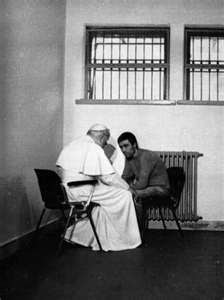
On May 13, 1981 a Muslim assassin named Mehmet Ali Agca shot Pope John Paul II four times during a public appearance in the square outside the Vatican. Though the assassin’s intentions was obviously to kill, the Pope survived. The assailant was arrested, tried, and sentenced to a 19-year term in an Italian prison. Two years after the assassination attempt, the Pope visited the man who shot him. No one knows for sure what transpired between the men, other than that the Pope forgave his assailant. Here is one example of Christian mercy shown to a great sinner, a mercy that overwhelms great sin, showing a pattern that began with Jesus.

I have heard a folk tale that offers an answer to the question of the eternal destiny of Judas. According to this tale, a long time after Judas’ death, he gradually came to consciousness and found himself in utter darkness, lying flat on his face on dank ground oozing with filth. He was exhausted. For a thousand years he lay there, agonizing over what he had done. Then with a groan he rolled over. He saw a tiny point of light away high above him, and he realized that he was in a deep, deep pit—a hole with sheer sides made of slime and mud. For three thousand years he contemplated that hole and the pinpoint of light high up. Then he dragged himself to his feet and began to try to climb out. For five thousand years he climbed, groping upward and sliding back down. At the end of the five thousand years his hand gripped the top edge of the hole, and he pulled himself out and lay gasping on the ground above. After a thousand years he had regained his strength and looked up. He saw Jesus and the Eleven, sitting at table, radiant with glory. There was one seat vacant. Jesus said, “What took you so long?”

It is only a story. We don’t know, and cannot know, what Judas’ eternal destiny is. It is not really our business. Jesus, probably referring to Judas, says that “the son of perdition” is lost “that the scripture might be fulfilled” (John 17:12), but even this passage does not make clear the irrevocable condemnation of the son of Simon Iscariot. Peter said merely that Judas “turned aside, to go to his own place” (Acts 1:25). What these things mean, what Judas’ eternal destiny is, is not our business.

But it is obvious that the story of Judas is also the personal story of each Christian and every human being. And this is our business.

No woman has ever borne a child,

And worshipped his eyes and the way he smiled,

And reacted with pride at his first clear word;

Who bound up his hurts and loved his absurd

Fierce concentration, watching a spider;

Who saw him grow till he stood beside her,

...

Some say he was wrong, some say he was right

In the way he did that dark spring night.

I only know what is done is done,

And I weep for Judas ... I weep for my son.

The story of Judas is the story of horrible sin and sacrificial love, forgiveness, and reconciliation—the true story in which Jesus’ love is proven stronger than the worst sin of all time. That is everyone’s business. In the end it is the only business that matters.